Walking the Dunes at Enniscrone Beach on a January Morning
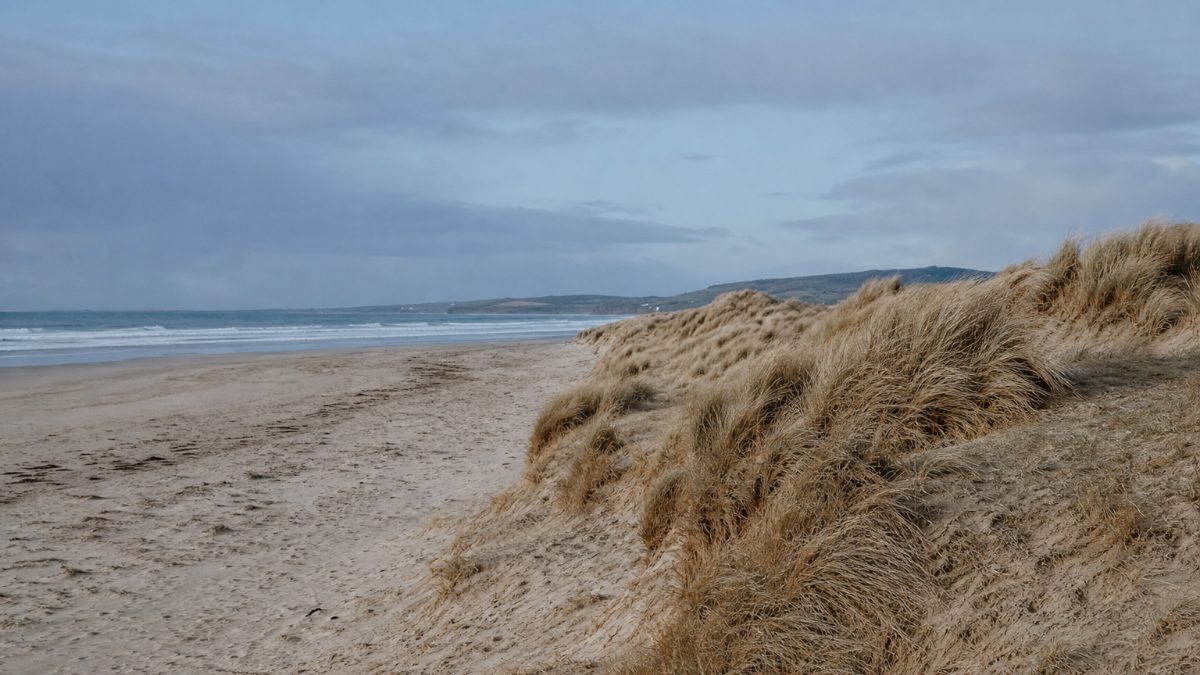
There is something about Enniscrone beach in January that you either love straight away or find completely baffling. The sky is usually the colour of old pewter, the wind comes in off the Atlantic without any interest in being polite, and there is a good chance you will have the whole place to yourself. I went out last week on one of those mornings, not quite eight o'clock, when the light was still making up its mind.
I started at the seaweed baths end, where the road comes down and the car park sits empty most winter mornings. The sand up there is firm enough near the waterline but you are not sticking to the waterline today. The idea was to walk the dunes all the way along to the river mouth at Killala Bay, keeping mostly to the dune line rather than the flat beach. I had done it in summer before but never in this kind of light and cold.
The first thing you notice is the footing. The dune grass, the marram, is dry and stiff in January and it grabs at your boots in a way it does not in warmer months. The sand underneath can be loose even where the grass looks like it would hold you. I slipped twice in the first ten minutes, nothing dramatic, just that sudden sink where your back foot drops a few inches more than expected. Decent boots with ankle support make a real difference here. I was wearing trail runners and they were fine, but I would not have wanted anything lighter.
Moving away from the baths and heading south, the dunes build up and then flatten and then build again. There are hollows between the ridges that trap the wind and go almost quiet, which after fifteen minutes of the Atlantic coming at your face feels genuinely surprising. You can stand in one of those hollows and hear almost nothing except your own breathing. In January that stillness feels like a small gift.
What you can see in low winter light
People talk about winter light as if it is a problem to be overcome. I think they are wrong. By half eight the sun was up but low, sitting somewhere behind a band of cloud out over the bay, and the light it threw was flat and grey and completely unforgiving in the way it showed up every ripple in the sand and every bleached stem of dune grass. The colours were muted. Straw, pale sand, dark wet rock further out. The sea was a cold green-grey with white at the edges.
I spotted a few oystercatchers working the tideline and something I could not identify at distance, something small and very quick along the sand. The lack of walkers and dogs meant the birds were not bothered and went about their business without paying me much attention. That alone is worth the cold.
The middle stretch of the dunes, roughly the section in front of the golf course, is where the ridge gets highest and the views open out properly. On a clear winter morning you can see north towards Killala and beyond, and south to the headland. I stopped there for a while. I had a flask of tea and I sat out of the wind on the seaward slope with the dune at my back and drank it watching the tide pull out.
The river mouth end
The walk down to the Moy estuary end takes longer than you think from the high point of the dunes. The ground gets rougher and wetter as you close in on the river mouth. There are soft patches close to the estuary edge that look fine and are not. I turned back about two hundred metres short of the actual river channel after my left boot went in almost to the ankle. Worth knowing before you commit to it in winter.
The whole walk took me about an hour and forty minutes at an easy pace, turning back where the ground went soft. Coming back along the flat beach rather than the dunes is quicker and your legs will probably thank you for it by that point. The beach sand is firmer on the return because the tide had dropped further and you get the last of the morning light at your back all the way to the car park.
Bring more tea than you think you need. That much I can tell you for certain.